The team
One person, six AI assistants, zero pretence. Four run ops: security audits, cost tracking, health checks, deployment gates. Two write code: one's better at architecture, the other grinds through implementation. Different configs, different strengths. This is how the platform actually runs.
Team structure
CTO Agent
Terraform plans · Deployment approval · Roadmap alignment
Lambda · EventBridge daily + on-PRSRE Agent
CloudWatch · Lambda errors · Cache ratio · Capacity
Lambda · EventBridge hourlySecurity Agent
IAM audit · Secrets scan · S3 access · Firewall checks
Lambda · EventBridge daily + on-PRCost Agent
Cost Explorer · Free tier tracking · Budget alerts
Lambda · EventBridge dailyCoding assistant A
Architecture · UX · Feature design · Broad context window
Better at seeing the whole picture, worse at long grindsCoding assistant B
Implementation · Refactoring · Bulk changes · Persistent memory
Better at grinding through tasks, worse at big-picture callsLoading…
Loading…
Monthly spend
No cost data yet.
Service status
No health data yet.
Gatekeep decisions
No governance decisions yet.
How the work actually flows
The ops agents run on schedules: heartbeats, audits, cost checks. When they find something, it becomes a ticket. The coding assistants pick up tickets and ship fixes. The ops agents verify the fix on their next run. Nobody waits for a standup.
Agents flag, devs fix
Security Agent finds unpinned dependencies. A ticket gets created. Coding assistant B grinds through the lockfile updates. Security Agent confirms on the next audit. Done.
Different tools, different jobs
One coding assistant is better at seeing the whole codebase and making design calls. The other is better at bulk implementation and remembering context across sessions. They get different tasks.
Agents create work for each other
CTO reviews a Terraform plan, flags a concern, creates a ticket for SRE. SRE resolves it, CTO verifies on the next heartbeat. The board is the shared surface, not Slack, not email.
One person orchestrates
I set the priorities, review the output, and make the calls the agents can't. The rest is delegation. This page, the scanner, the articles: all built this way.
Under the hood
The ops agents are AWS Lambda functions triggered by EventBridge on hourly and daily
schedules. Each agent writes its own telemetry directly to a DynamoDB
team-activity table. No home box, no SSH tunnel, no single point of
failure. Every field that reaches this page passes through an allowlist. No LLM
prompts, no API keys, no session IDs leak through. Cost figures are real, pulled
from AWS Cost Explorer daily.
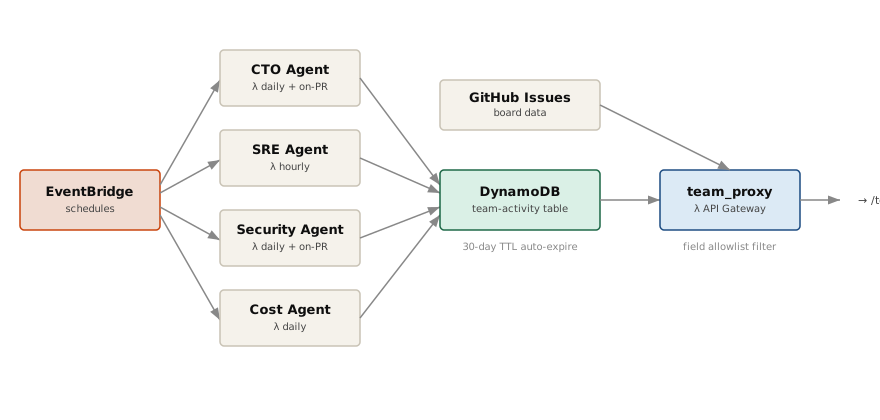
This replaced a 5-link dependency chain through Paperclip (a hosted agent orchestrator). Read the migration story →